Back to blog
What NFTs Can Teach Us About Tokenizing Real-World Assets (RWAs)

NFTs: Buzzword, misconception, hot topic for the dinner table. But seriously, NFTs have a wide range of utility. NFTs are blockchain-based digital assets that represent ownership or proof of authenticity of unique items or digital content. That’s real, and they’re extremely important. NFTs can represent ownership on-chain while keeping asset data off-chain, so the data is verifiable. What NFTs can teach us is important for the next wave in Web3, tokenizing real-world assets. As Matt wrote, tokenizing RWAs isn’t a token problem; it’s a data problem.
NFTs Don’t Just Represent Art, They Solve a Storage Pattern
NFTs don’t actually contain the art. For ERC-721 NFTs specifically, they are:
- unique
- ownable
- transferable
This distinction matters because it’s the same structure needed for RWAs.
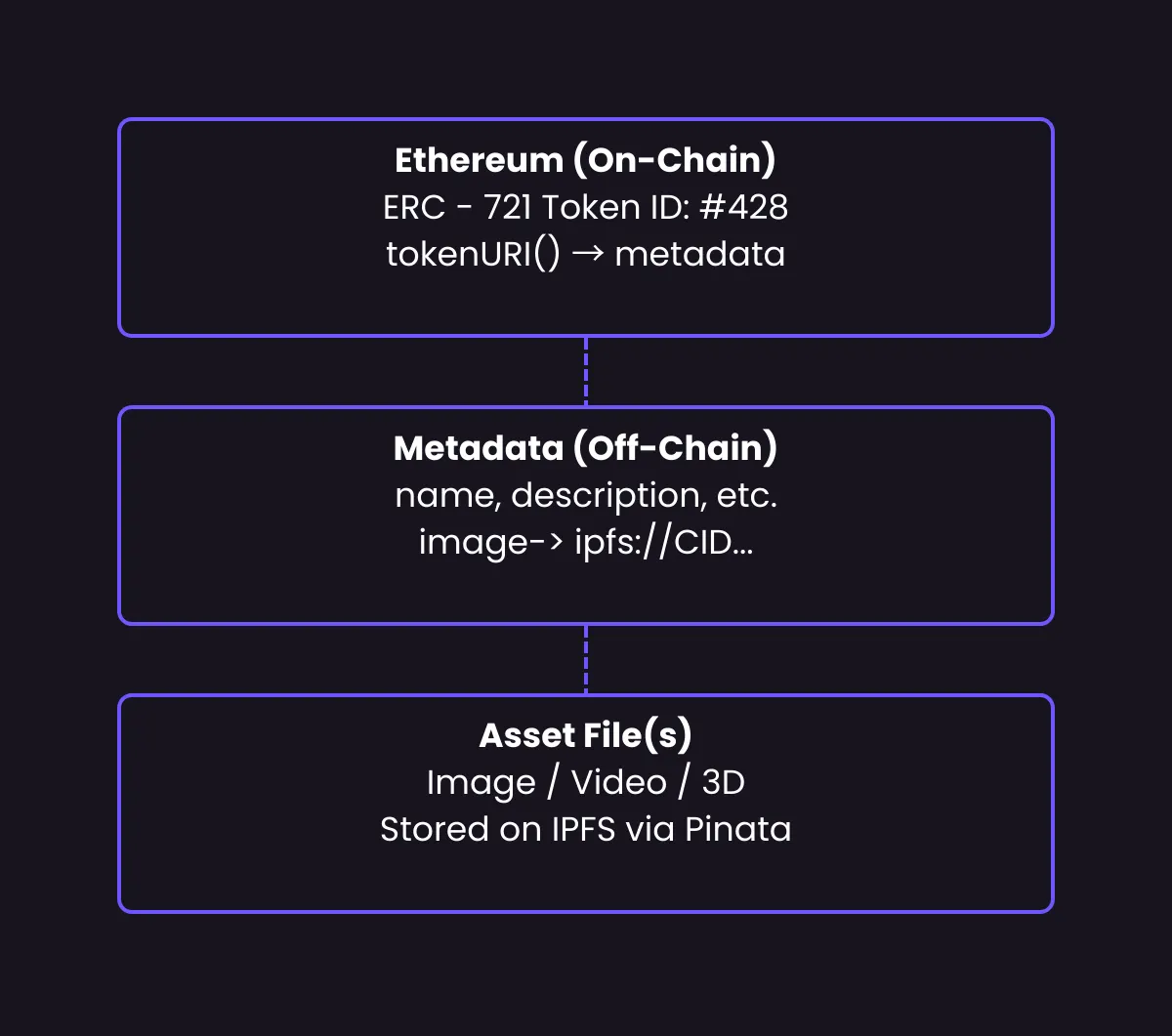
This architecture that made NFTs scalable is the same architecture RWAs will need, except RWAs will involve more data, complexity, and stakes.
Tokenized RWAs Have the Same Problem NFTs Had
When you tokenize a real-world asset, you’re not tokenizing “a file”. You’re tokenizing a thing that comes with:
- legal documents
- compliance data
- history of ownership
- appraisals and valuations
- maintenance and records
- images and supporting evidence
- audits and attestations
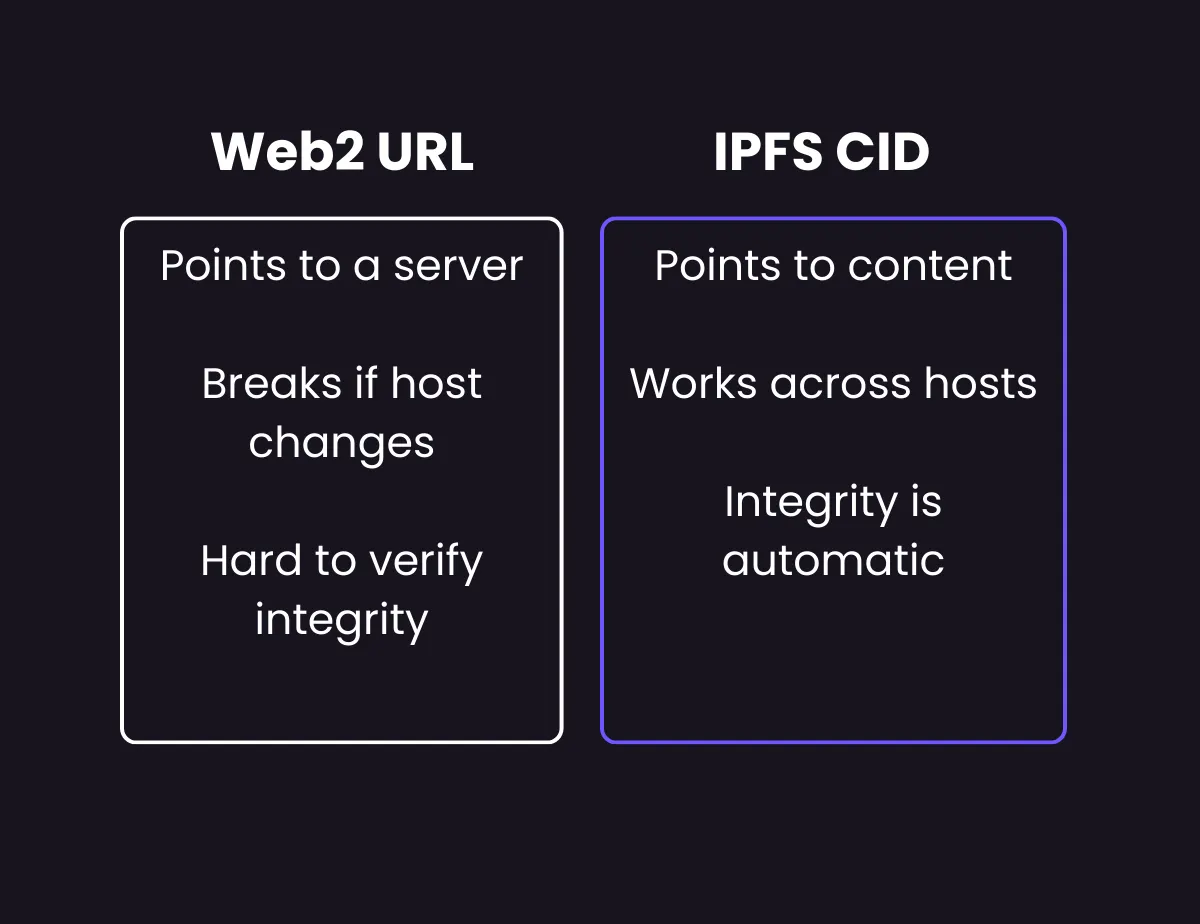
The blockchain wasn’t designed to store large files or constantly changing documents. If a tokenized asset's token points to a standard URL, it will still rely on the same fragile infrastructure that Web3 is replacing. If the URL breaks or changes, the tokenized asset becomes a token pointing to nothing.

IPFS, Pinata, and the Missing Infrastructure Layer for Tokenized Assets
NFTs are a practical solution: store large data off-chain, but make it verifiable
That’s what Pinata does: Pinata enables IPFS to scale.
Currently, you access data like this:
https://examplewebsite.com/files/asset.pdf
This is location-based, meaning it assumes the server stays online, the URL never changes, and the host is trustworthy.
With IPFS, you access data like this:
https://examplewebsite.com/ipfs/bafybeigq7k4m2x6n3yqv7r5u2a6c4p7z9w1x8e3t6r0k5m4n2p1q0s
Now, it’s content-based. The CID is generated from the content itself, so if the file changes, so does the CID. This is why IPFS became foundational for NFTs and also works for RWAs.
Ownership
One of the most useful ways to think about ERC-721 isn’t “an image”, it’s a unique certificate that can reference data.
For NFTs, that data might be an image, but it can also be:
- attributes
- a collection name
- provenance
For RWAs, the data might be:
- a deed
- legal structure
- proof of custody
- reports
- documents
- valuation history
ERC-721 is the identity layer, and IPFS is the truth layer. Pinata makes both of these available, aka, the availability layer.
NFT metadata is usually lightweight compared to RWA metadata. Tokenizing RWAs requires handling large, numerous, sensitive files that may be updated over time. NFTs taught us that a token can represent ownership of a bundle of off-chain data, provided the data is stored in a verifiable way. NFTs also taught us a valuable, but painful lesson that if the data disappears, the token becomes meaningless. That’s why storage resilience is so important and why we created NFT Backup. Resilience is critical for RWAs too. If a tokenized real estate asset loses its associated legal documents, that would be catastrophic.
With Pinata, the goal is to prevent failure mode by ensuring:
- The content is pinned
- The content stays available
- The references remain verifiable
With RWAs, permanence is the whole point.
What NFTs Teach Us About Provenance (and Why RWAs Need It)
One of the biggest reasons NFTs work is that they create a shared language for provenance. This includes: who minted it, who owns it, which collection it belongs to, and what the asset is intended to represent. With RWAs, that provenance is the difference between a legitimate asset claim and a counterfeit or fraudulent representation. NFTs normalized the idea that provenance should be public and verifiable, which is something RWAs can inherit. Lastly, there’s a bridge between NFTs and RWAs that comes from managing AI files with ERC-721. In both AI workflows and RWAs, the asset isn’t static. It produces data, and ERC-721 can still serve as the identity anchor while the evolving data trail is stored on IPFS. NFTs are the blueprint for the adoption of token + data architecture.
The Business Model of RWAs
Tokens can represent rights. In the same way NFTs can represent ownership, access, and membership, tokenized RWAs can represent usage rights, revenue shares, licensing rights, and gated access to data. When asset data lives on IPFS, you can control access to data, monetize access, and build a business model around data distribution. With RWAs, the asset isn’t the only valuable piece. The data about the asset is valuable, too.
NFTs proved something critical: that you can represent ownership on-chain without forcing all data to be stored on-chain. You can store the asset off-chain without sacrificing integrity, and you can create systems where tokens point to verifiable content using Pinata. NFTs were the first large-scale demonstration of how tokenized assets work, and RWAs are the next iteration.