Back to blog
Metadata is Valuable. Here’s How to Monetize It

Metadata, often described as “data about data”, is what gives content meaning. It defines what an asset is, how it’s displayed, and how it’s used. Metadata can be the most valuable data you publish, so why is it treated like an afterthought?
CIDs, openness, and the metadata problem
IPFS (Interplanetary File System) uses content identifiers (CIDs) to reference data. The benefit of CIDs is that they are immutable and tamper-proof. A CID uniquely represents the contents of a file, and any changes to that file result in a new CID. This makes IPFS a powerful way to store and reference data that needs to be verifiable and trustworthy.
Historically, data stored on IPFS, including metadata, has been openly retrievable using Public IPFS. The pattern is pretty simple: upload content, generate a CID, allow anyone with the CID to access it. This pattern led to the assumption that, to have immutable, verifiable data, it had to be publicly accessible. But immutability and public access aren’t mutually exclusive. You can have an immutable, tamper-proof CID while intentionally limiting access. Metadata is a perfect example of where this distinction can matter. When metadata is stored on Public IPFS, anyone with the CID can access it.

This made sense for many early use cases, especially NFT platforms, where metadata needed to be readable by anyone, anywhere. But over time, metadata has become more valuable. Metadata can power pricing models, unlocks, gated experiences, analytics, and more. Creators and businesses want the benefits of content addressing, such as immutability and verifiable data, without having to give up control over access, timing, privacy, or monetization.
Why metadata is often public
Metadata is often public because IPFS was built for open content distribution. Early IPFS workflows assumed content should be retrievable by anyone with the CID. Metadata followed the same pattern.
In many early applications, metadata wasn’t regarded as sensitive or monetizable. Metadata was just supporting information, not the primary source of value. Historically, when access control was needed, it was typically handled at the application layer using APIs, servers, or databases. Now, use cases have evolved, and metadata has become more than just descriptive information. Metadata can drive value directly. Public metadata isn’t the only option; it’s just the most common one.
Is public metadata always best?
Public access works for many use cases, but it’s not always the right choice. IPFS being public by default is a design choice, not a requirement. When you need to manage access or distribution of your data, IPFS can still be your underlying infrastructure. What changes is how access to the CID is handled.
Pinata’s Private IPFS allows for restricting access to files and metadata while keeping content addressing and verifiability. The CID remains immutable and tamper-proof, but retrieval is only possible when the right conditions are met.
When to use Pinata’s Private IPFS for metadata
Public metadata can be indexed, scraped, or shared in unintended ways, like before a project is ready to be seen. It can also reduce utility, because unrestricted access makes it harder to connect value with payments.
Using Private IPFS for metadata changes that dynamic. Metadata can retain its CID while access is limited to approved users, applications, or systems. This enables tons of use cases, like staged releases, gated experiences, premium features, or privacy preservation, without relying on external platforms to enforce access rules.
Private IPFS keeps the original CID for immutability and verification, while allowing creators and businesses to decide when and how metadata is revealed.
Monetizing metadata with Pinata’s x402
When you manage access to metadata, it becomes something you can monetize rather than give away.
At a concert, the performance is the value, and access to the performance is what’s sold. Tickets are required at entry, not after the performance, hoping attendees decide to pay afterward. Metadata works the same way. Defaulting to publicly accessible metadata means creators are essentially putting the most valuable data in the open and attempting to monetize around it. If you manage access to metadata first, you can align payment with the moment the value is delivered.
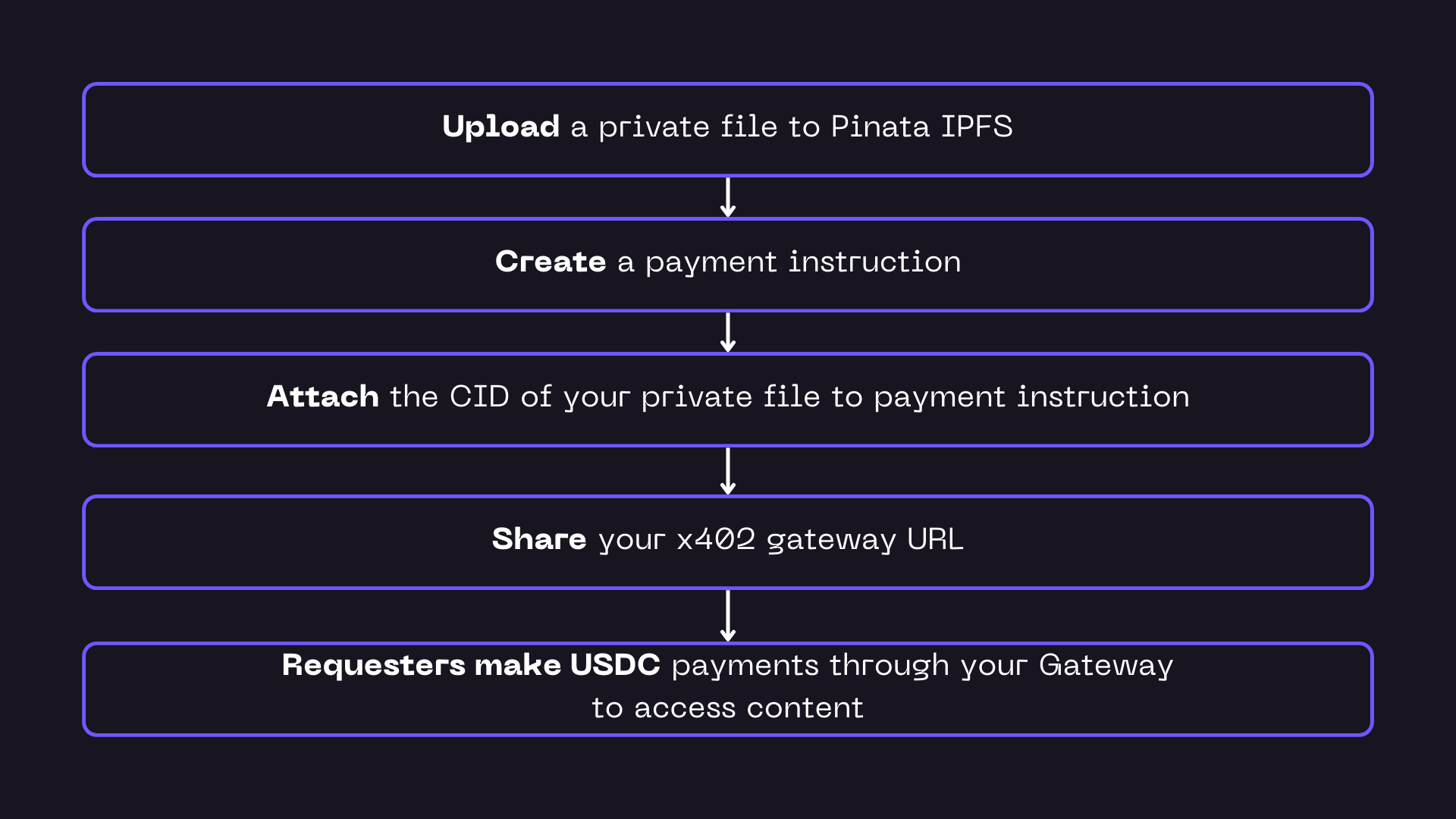
Pinata’s Private IPFS makes this possible, and Pinata’s x402 adds monetization. With Pinata’s x402, payment conditions can be attached to files stored on Private IPFS. Access is restricted until the payment conditions are met using a dedicated gateway, then payments are received directly in the creator’s wallet in USDC. This creates a direct value exchange between the creator or business, and the consumer.
Some metadata will always be public, just like some concerts are free. But when metadata is valuable, creators and businesses should be able to treat it that way.
Using Private IPFS and x402, metadata can remain immutable and verifiable, access can be intentional, and monetization can be native. Storing metadata on Private IPFS changes how value, ownership, and revenue are managed. And, it’s only the beginning of what’s possible.